
Disability insurance explained in one line: it pays you part of your paycheck when illness or injury keeps you out of work. If your income stopped tomorrow, how long could you keep the lights on? Right now is the cheapest moment of the year to fix that: open enrollment is open, and searches for disability insurance are up 30 times over last year.
Key Takeaways
- About 1 in 4 of today’s 20-year-olds will become disabled before retirement age.
- Policies typically replace 40% to 70% of income, at 1% to 3% of annual pay.
- SSDI pays about $1,634 a month on average in 2026, with a five-month wait.
- Open enrollment is your one annual window to add or upgrade coverage.
What Is Disability Insurance, Really?
Disability insurance is income protection: if a bad back, cancer treatment, a mental health crisis, or a complicated pregnancy keeps you from working, it sends you a monthly check until you can work again.
It is not health insurance — health insurance pays your doctors; disability insurance pays your rent. Nor is it workers’ compensation, which only covers on-the-job injuries.
The odds are higher than most people think: about 1 in 4 of today’s 20-year-olds will become disabled before age 67, and 75% of employees would struggle to pay basic bills after several months without a paycheck — yet only about 20% own disability coverage.
“A 35-year-old worker earning $75,000 a year who becomes permanently disabled could lose up to $2,250,000 in potential earnings by age 65.” — MassMutual
Short-Term vs Long-Term Disability Insurance
Two types work as a relay team: short-term covers the first stretch, long-term takes over after that.
| Feature | Short-Term Disability | Long-Term Disability |
|---|---|---|
| What it replaces | Typically 60% to 70% of base salary | Typically 40% to 60% of base salary |
| How long it pays | A few months to one year | 2, 5, or 10 years — or until retirement age |
| Waiting period | About two weeks | Commonly 90 days |
What Does Disability Insurance Cost?
Less than most people guess: a long-term policy generally costs 1% to 3% of your annual income, per NerdWallet and Life Happens. On a $75,000 salary, that’s roughly $750 to $2,250 a year — about $60 to $190 a month.
Three things move the price: age and health, occupation, and your elimination period — the wait before benefits start. A 90-day wait is most common; a 180-day wait costs less, but you need savings to bridge six months.
What Social Security Actually Pays (and Why It’s Not a Plan)
A lot of people assume the government has them covered. It doesn’t — not really: SSDI paid disabled workers about $1,634 a month on average in early 2026, roughly a quarter of a $75,000 paycheck.
SSDI has three catches: a strict definition (unable to work 12+ months), a five-month wait, and many first applications denied. The program is also under strain: the retirement trust fund is projected to pay only about 78% of scheduled benefits after late 2032 unless Congress acts — see our Social Security trust fund post.
The 2027 cost-of-living adjustment helps a little — 3.6%, announced October 14, 2026, the largest since 2023, with higher payments from January 2027. But a raise on a small benefit is still a small benefit. SSDI is a floor, not a plan.
How Much Coverage Do You Need?
Start with the 60% rule: aim to replace about 60% of your gross income.
Then check two things: your emergency fund — six months saved means you can afford a 180-day wait and a lower premium — and whether the policy is “own-occupation” (your specific job) or “any-occupation” (any job). Own-occupation costs more and protects more.
If you are self-employed, an individual policy is your only option — apply while you are healthy, because underwriting gets harder after a diagnosis.
The 5-Minute Open Enrollment Check (Do It This Week)
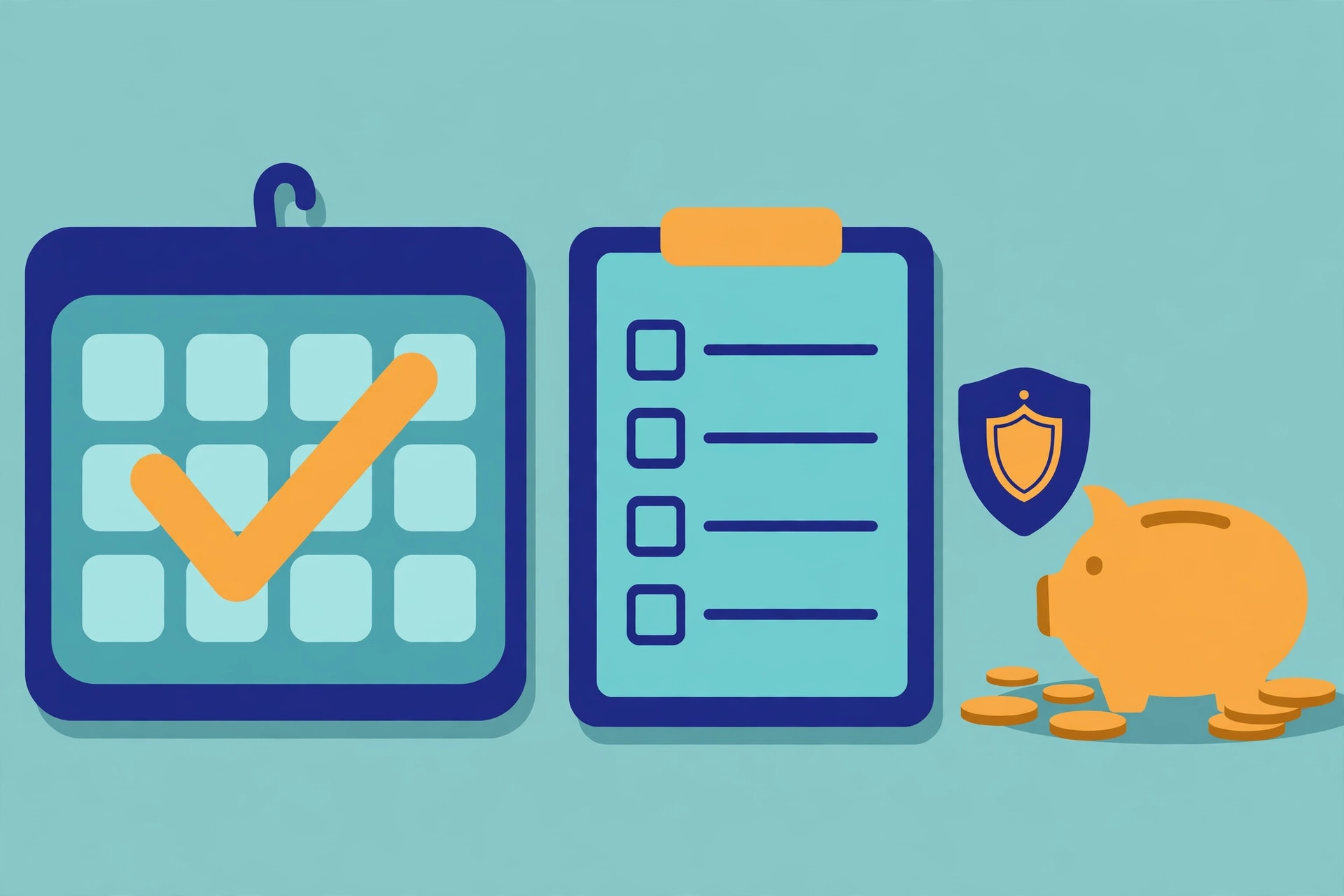
Open enrollment is the one time of year you can add or upgrade group coverage without a qualifying life event. The ACA window runs November 1 to January 15; most employer windows close by early December. Five questions:
- Open your employer’s benefits portal and find the disability section.
- What percentage of your pay does it replace, and is there a monthly cap?
- What is the elimination period — 90 days, or longer?
- How long do benefits last — two years, five years, or to retirement age?
- Does the coverage follow you if you leave the job?
If any answer is “I don’t know,” close that gap this week. If your employer offers no long-term coverage, get one individual quote before open enrollment ends.
Do this: check your group coverage during open enrollment, build your emergency fund toward six months, and get a quote if you are self-employed.
Skip that: assuming SSDI will cover you, waiting until you are sick to apply, or buying the cheapest policy without checking the elimination period and benefit cap.
Bottom Line
Disability insurance is not exciting, and that is the point. It sits quietly until the one month your life falls apart — then it is the difference between a rough year and a financial wipeout. One in four of us will need it, it costs about 1% to 3% of pay, and the window to set it up is open right now.
This article is for general information only and is not financial or insurance advice. Coverage, prices, and availability vary by insurer and by US state. Talk to a licensed insurance agent or a qualified financial professional before choosing a policy.
FAQ
What does disability insurance cover?
It replaces part of your income — typically 40% to 70% — if illness or injury keeps you from working. It covers everyday-life disabilities: back injuries, cancer, mental health conditions, pregnancy complications.
How much does disability insurance cost?
A long-term policy generally costs 1% to 3% of your annual income — roughly $750 to $2,250 a year on a $75,000 salary.
Is disability insurance worth it?
For most workers, yes. About 1 in 4 of today’s 20-year-olds will become disabled before retirement age, and 75% of employees would struggle to pay basic bills after months without a paycheck.
Does Social Security Disability Insurance (SSDI) cover me if I can’t work?
SSDI helps, but it is limited: about $1,634 a month on average in 2026, a strict definition of disability, a five-month wait, and many first applications denied.
Can I get disability insurance if I’m self-employed?
Yes. Self-employed workers can buy individual policies directly from insurers any time of year. You will face medical underwriting, so applying while healthy gets better rates.
1 thought on “Disability Insurance Explained: Why It Matters in 2026 (and What It Really Costs)”